Six signs a tree needs to come down
Not every problem tree is a removal. But some are, and waiting on those gets expensive. Here's what we look at first.
July 2, 2026 · 5 min read
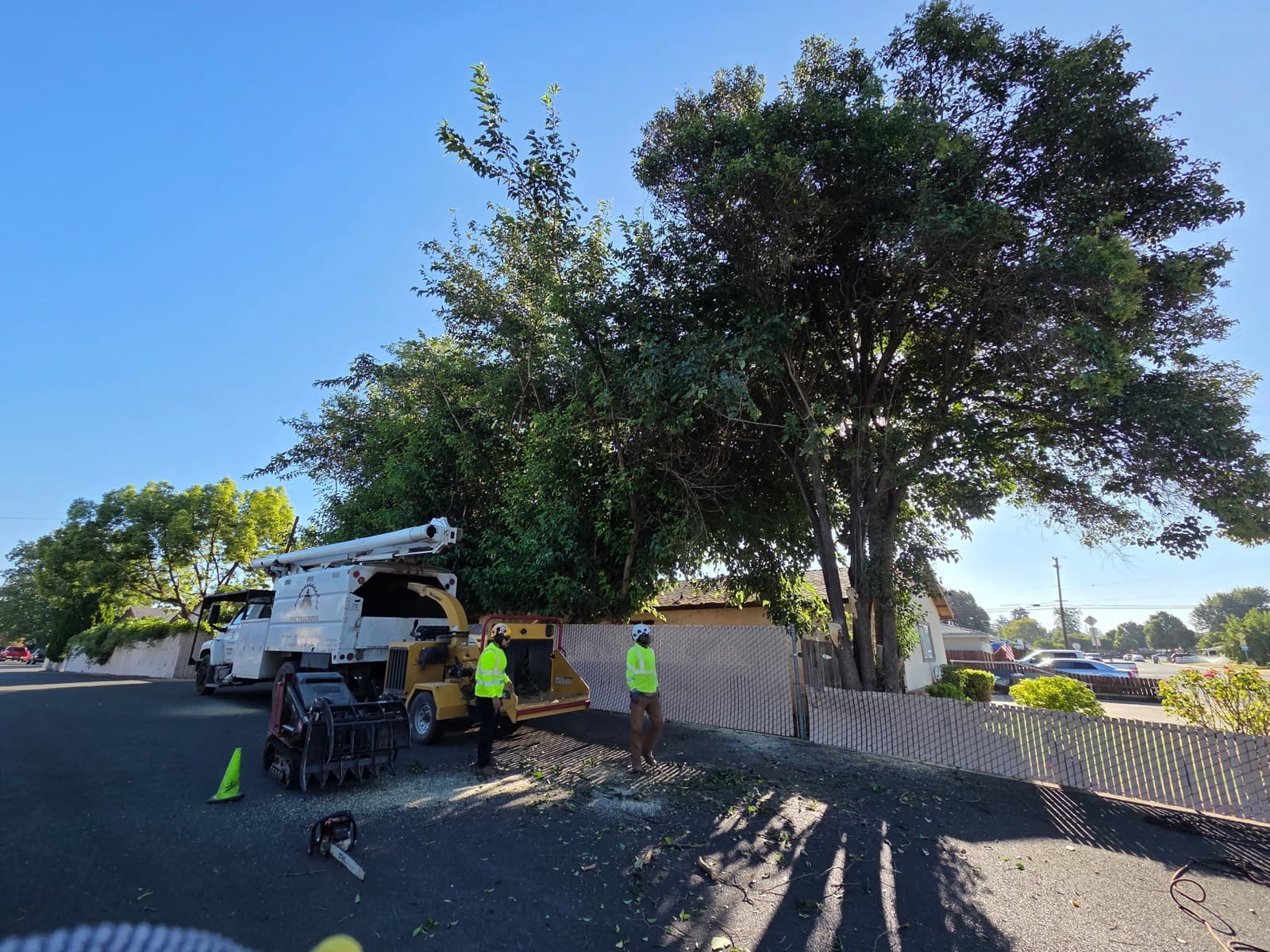
Most of the calls we get start the same way: someone has looked at a tree in their yard long enough to start worrying about it. Sometimes they're right. More often the tree needs deadwood cleaned out and some weight taken off, not a stump.
Here's the short version of what we look at when we walk a property, roughly in the order of how much it worries us.
1. A lean that's gotten worse
A tree that's always leaned is usually fine — it grew that way and built wood to match. A tree that has started leaning is a different story, because something under it moved. Look for cracked or heaving soil on the side opposite the lean. That's the root plate lifting, and it doesn't recover.
2. Mushrooms or conks at the base
Fungal fruiting bodies at the trunk flare mean decay inside the wood you can't see. By the time a conk is visible on the outside, the fungus has usually been working through the structural wood for years. This is the one homeowners most often dismiss and shouldn't.
3. Cracks in the trunk or a major fork
Vertical splits, and included bark where two stems meet in a tight V, are how big limbs come apart. A V-crotch with bark pinched inside it never forms a proper structural union, so it's a seam waiting to open under wind or its own weight.
4. Deadwood in the upper canopy
Bare branches at the top of an otherwise green tree usually mean the root system is failing. Trees shed from the top down when they can't move enough water, so upper-canopy dieback is a root problem showing up sixty feet away from the roots.
5. Roots lifting hardscape
Driveways, walkways, foundations, and sewer laterals. Once it starts it doesn't stop, and the fix is usually either the tree or the hardscape. Worth deciding before the repair bill makes the decision for you.
6. Storm damage
A tree that's lost a third or more of its canopy rarely recovers into a stable structure. It will push a lot of weak new growth, which looks like recovery and isn't. A broken limb or two on an otherwise sound tree, on the other hand, is just a pruning job.
What this looks like in Sacramento
The trees we remove most often around here are silver maples and Modesto ashes planted through the postwar neighborhoods — Arden-Arcade, Carmichael, Land Park. Weak wood, poor structure, decay at the unions, all reaching the end of their run at roughly the same time.
Valley oaks are the ones we work hardest to keep. They drop massive limbs in summer heat with no warning, which alarms people, but summer branch drop on its own is not a reason to remove a healthy oak. End-weight reduction and deadwood removal usually handle it.
If none of the six apply to your tree, say so when you call. Plenty of what we look at needs crown thinning, not a stump, and we'd rather tell you that than sell you a removal.
Or call (530) 845-1134 — no pressure, no obligation.